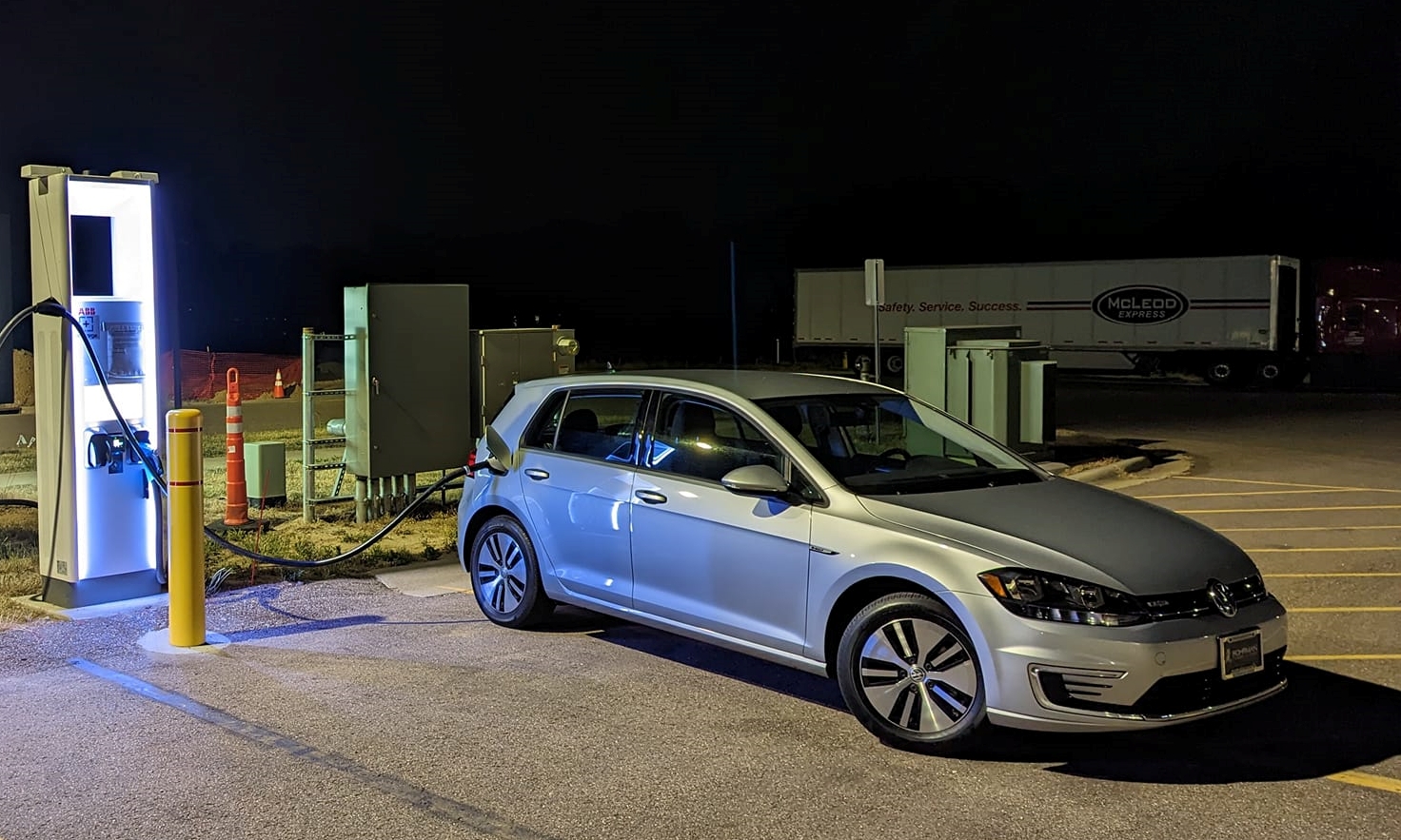
A few months ago I bought my first EV, a 2019 e-Golf. I selected the e-Golf not only because the price was quite attractive (even before the expected $4,000 tax credit) but because I like how it drives with a solid structure, excellent outward visibility, and composed-yet-agile handling. The last is partly due to the e-Golf’s curb weight. At under 3,500 pounds, it’s considerably lighter than most EVs. This curb weight is in turn possible because the e-Golf has a smaller battery pack than most current EVs. It can only go about 125 miles on a charge. (Pre-2017 e-Golf’s had even less range, about 80 miles). Then again, I rarely need to drive far, so why lug a super-heavy battery pack good for 200+ miles even when I only need to drive 20 miles? Charging on the road isn’t much of a solution. Even with the fastest current systems recharging to even 80 percent takes much longer than filling a convention car with gas, and rapid charging isn’t great for battery pack longevity. This got me thinking: ideally I could supplement the e-Golf’s built-in battery pack with additional modules. The more I thought about this solution, the better it seems.
Some companies have tried exchanging the primary battery pack as an alternative to rapid charging. The problem is, such packs are too large, heavy, and complicated for such exchanges to be quick or cheap, when then need to be both. The primary pack has to be complicated because it has to be capable of rapid charging and discharging, both of which require high voltage and produce considerable heat. Ideally the primary battery pack includes active thermal management to enable very rapid charging and discharging without damaging the battery (though the e-Golf’s does not). There’s no quick easy way to swap out such a pack.
But what if the exchangeable modules only served to recharge the primary pack at a relatively slow rate, so they didn’t have to be high-voltage, thermally managed, or otherwise complicated? Simple modules could be relatively small and light, for quick and easy swaps. Need more than one can provide? Then design the vehicle to use more, much like devices use varying numbers of AA batteries. Small modules would also enable a standardized module to be used by many different vehicles from different manufactures. Swapping these modules could be quicker and easier than filling a conventional car with gas. How long does it take to change the batteries in a flashlight?
This would have benefits beyond enabling EVs to get back on the road more quickly. Recharging EVs doesn’t only take a lot of time. It will also require a lot of space. If it takes even five times as many minutes to charge an EV as it does to refill with gas, then recharging facilities will have to occupy five times as much space as gas stations currently do. This clearly isn’t a great idea.
But if you’re only recharging modules that are far smaller than an entire car, much less space would be required. This could even be done well off the highway. What’s more, it could be done relatively slowly and thus at a lower temperature, which would be good for both energy conservation (heat is wasted energy) and battery pack longevity.
These modules would also provide a solution for people who cannot charge an EV at home. Pick up some modules and let them charge your car overnight wherever you park it, then return them later.
One concern I can envision involves theft. The battery modules would be fairly valuable and if they can be swapped quickly and easily then can also be stolen quickly and easily. Clearly each would need some sort of tracking and theft prevention system built-in, along with a way to disable modules reported as stolen. This seems doable enough. But would this lead to concerns with privacy? Perhaps, though many current cars are already connected to the internet.
So, I can think of many advantages to the above system and just one concern which doesn’t seem to be a insurmountable. Why isn’t this a better way to go than large, heavy, expensive built-in battery packs plus rapid (but far from quick) recharging?